
Building Resilient and Smart Urban Infrastructure for Future Cities
- Magdy • Dec 17, 2025
 Facebook
 Twitter
 Linkedin
 Whatsapp
 Telegram
 Instagram
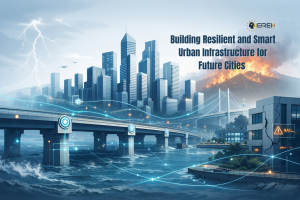
Introduction: Structural Engineering at a Turning Point
Urbanization, climate volatility, and regulatory pressure are converging to challenge long-standing assumptions in structural engineering. Cities are no longer static entities governed by predictable loads and stable boundary conditions. Instead, they are dynamic systems exposed to compound hazards, accelerated material aging, and evolving social and environmental demands. Within this context, resilient and smart urban infrastructure has emerged as a research-driven response rather than a design slogan, requiring new analytical frameworks that integrate uncertainty, adaptability, and long-term performance.
For researchers and advanced practitioners, the central question is no longer how to optimize isolated structures, but how to design structural systems that remain functional, safe, and resource-efficient across uncertain futures.
Climate Uncertainty and the Limits of Conventional Design Paradigms
Design codes have historically relied on probabilistic models calibrated to historical data. However, climate-induced shifts in hazard frequency and intensity challenge the validity of these assumptions. Flood loads, thermal stresses, wind extremes, and seismic interactions increasingly fall outside the statistical ranges embedded in existing standards.
For example, the 2022 floods in Germany and Belgium exceeded all historical flood return periods used in local structural design codes, causing extensive bridge and building failures. Similarly, in California, unexpected wildfires and associated windstorms have led to the collapse of structures previously deemed safe under conventional seismic and fire design assumptions. These events highlight the growing mismatch between historical data-based codes and real-world hazards under changing climate conditions.
This has accelerated interest in performance-based seismic design, where explicit performance objectives replace prescriptive detailing rules. While such approaches offer flexibility, they remain unevenly implemented and often focus on single hazards, neglecting multi-risk interactions common in dense urban environments. The lack of harmonization between climate projections and structural reliability models remains a critical unresolved issue.
Adaptive Structural Systems and Urban Resilience
The concept of adaptive structural systems reflects a shift from resistance to responsiveness. These systems incorporate mechanisms—such as reconfigurable components, energy-dissipating devices, or material phase changes—that allow structures to adjust their behavior under varying conditions.
From an urban resilience perspective, adaptability must extend beyond individual buildings. Structural interdependencies across transportation networks, utilities, and public spaces amplify local failures into systemic disruptions. Research increasingly emphasizes network-level robustness, redundancy, and recovery speed rather than isolated safety margins.
In this broader context, resilient and smart urban infrastructure is framed as a systems-engineering challenge, where structural performance, governance, and data flows intersect.
Digitalization and the Promise and Limits of Smart Monitoring
The rise of IoT-enabled structural monitoring has transformed how engineers observe and interpret structural behavior. Dense sensor networks enable continuous tracking of strain, vibration, temperature, and degradation, offering unprecedented insight into real performance versus design assumptions.
Despite its potential, scaling these systems across cities presents significant challenges:
Data interoperability across owners, jurisdictions, and asset types
Long-term sensor reliability and maintenance
Unclear legal frameworks governing data ownership and liability
Difficulty translating raw data into actionable engineering decisions
Without standardized protocols and robust analytical models, monitoring risks becoming descriptive rather than predictive. The gap between data availability and decision-making remains one of the most critical ba